If you work in crypto, you know what Telegram is really like. It’s not a messaging app. It’s a firehose. Every project, every community, every deal flow, every alpha group, every announcement channel. I was in over a hundred groups at my peak. Most of them I’d joined at some point for a reason that made sense at the time, a token launch I was tracking, a partnership discussion, a conference group chat that was supposed to be temporary.
They accumulated the way browser tabs accumulate. Slowly, then all at once, until opening Telegram meant facing a wall of unread counts that looked more like a scoreboard than a communication tool.
The problem isn’t that Telegram is bad. For what it does, it’s actually good. Real-time group communication, channels, bots, file sharing, voice chats. The crypto industry runs on it because it’s fast, it’s permissionless, and it’s where everyone already is.
The problem is scale. When you’re in a hundred groups and messages come in thousands per day, the signal-to-noise ratio drops to a level where the app becomes actively counterproductive. You either spend hours scrolling through irrelevant messages looking for the one that matters, or you stop checking entirely and miss things that cost you money or relationships.
I tried the obvious solutions first. Muting groups. Archiving. Creating folder categories. All of it helped marginally and none of it solved the core problem, which is that a human brain cannot efficiently triage thousands of messages across a hundred different contexts. The cognitive load of “which groups do I check first, what am I looking for, what can I ignore” was eating a chunk of my morning before I’d even started working.
So I built something. Through Claude Code, I set up a local MCP server that connects Claude to my Telegram account. MCP stands for Model Context Protocol, the same standard I use for Todoist (which I wrote about separately).
The Todoist connector is a first-party integration that works out of the box when you enable it. The Telegram connector is different. It’s a community-built, open-source MCP server called `telegram-mcp` that you clone from GitHub and run locally through Claude Code. You configure it yourself on your own machine. It’s a local server.
That distinction matters beyond the technical details. This MCP server runs on my computer. The data never leaves my machine. It’s not sitting in a cloud server somewhere processing my private messages. When I’m done for the day, when my computer is off, the connection is off. There’s no always-on service reading my Telegram in the background. I choose when the AI has access and when it doesn’t. For someone who deals with sensitive business communications, deal discussions, and financial information across Telegram, that level of control isn’t a nice-to-have. It’s a requirement.
The first thing I did with the connection wasn’t sophisticated. I cleaned house. I went through every group Claude could see and asked a simple question: “Which of these groups have I never sent a message in?” The answer was embarrassing. Dozens of groups where I was a silent lurker, adding to my unread count without providing or receiving any value.
Public groups that every crypto person joins because someone shared a link in a thread six months ago. Conference groups that stopped being relevant the day the conference ended. I left most of them in one session.
After the cleanup, the ongoing workflow is where the real value sits. I can ask Claude to summarize what happened in specific groups overnight. I can search across conversations for mentions of specific topics, names, or projects without scrolling through months of messages manually.
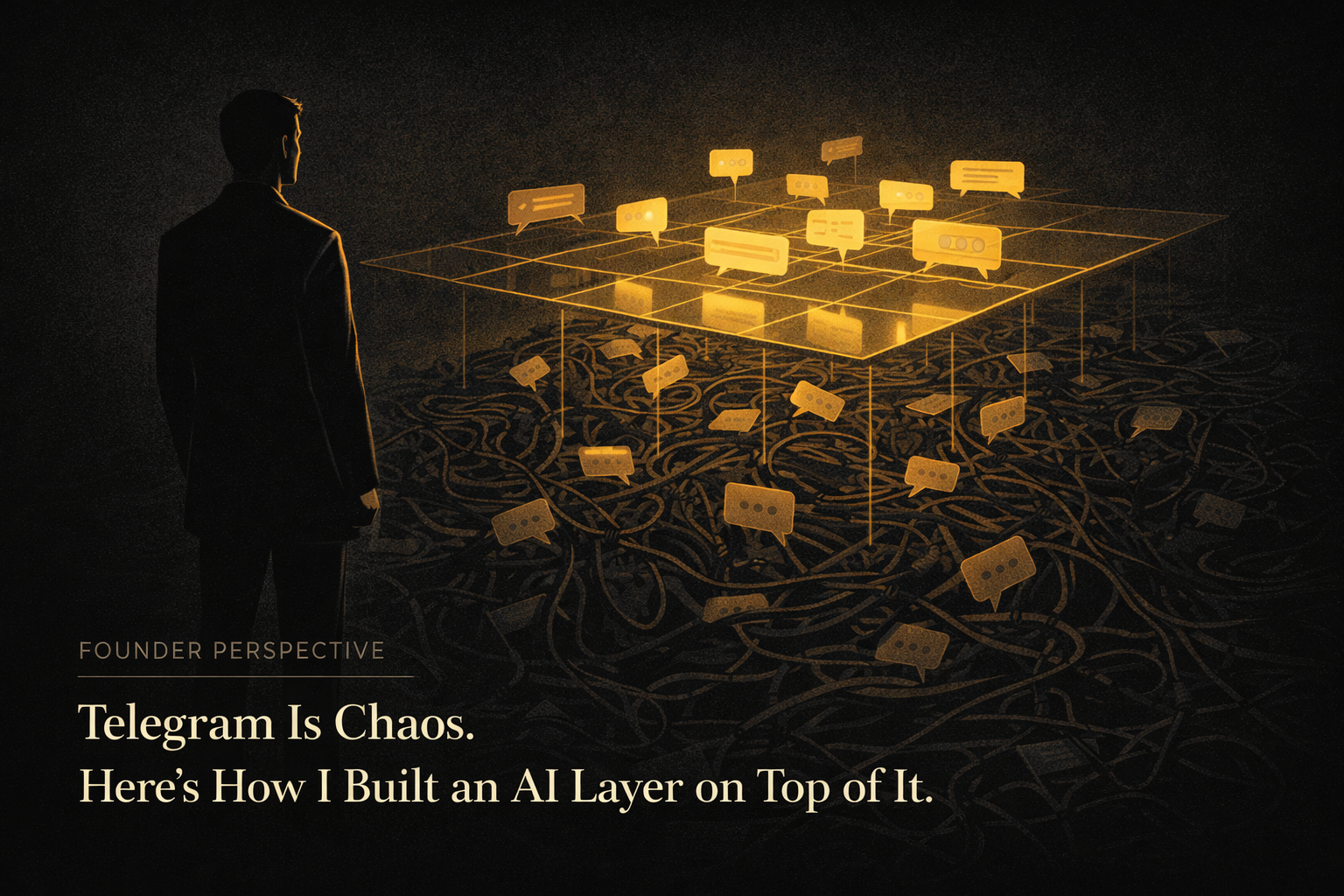
I can triage my DMs by having Claude surface the ones that need a response versus the ones that are informational. The wall of unread counts is still there (Telegram doesn’t change), but my relationship with it changed. I have an AI layer between me and the chaos, and that layer filters before I engage.
One note that surprised me and might save someone else frustration: this MCP does not handle archived messages. If you have Telegram settings that auto-archive messages from people not in your contacts (a common privacy setting), those archived messages are invisible to the MCP. My recommendation, and what I did myself, is to turn off that archive setting and manage triage through Claude instead. Better to see everything and let AI sort it than to hide messages you might need later.
I should address something I know some readers are thinking: why not use a fully autonomous agent for this? Tools exist that could run 24/7, monitor your Telegram, alert you proactively, even respond on your behalf. I evaluated several of them. I chose the controlled approach deliberately. In AI, especially when it touches your private communications, it’s not about what the tool can do.
It’s about the constraints you create. An always-on agent with access to all your messages and the ability to act autonomously is a different risk profile than a tool you invoke manually, on your computer, with full visibility into what it’s doing. Guardrails are the feature, not the limitation. Anthropic, the company behind Claude, is known for taking safety seriously. That reputation is part of why I chose this stack for my most sensitive workflows.
The thing that connects this to the broader approach I’ve been writing about is the ecosystem effect. My Telegram triage feeds into my task management (also running through Claude via Todoist). Information surfaced from Telegram conversations becomes context for business decisions I’m working through in Claude. The AI doesn’t just manage my messages in isolation.
It understands the broader context of my work, my priorities, my current projects. That shared context is what makes a consolidated AI stack more valuable than a collection of specialized tools, which is the argument I made in my earlier piece on tool consolidation. Not one tool for messaging, another for tasks, another for research. One system that sees all of it.
Telegram is still chaos. That hasn’t changed. What changed is that I have a competent triage layer between me and the chaos, running on my machine, under my control, with full context of what actually matters in my work right now.