Over the past few years I’ve had the opportunity to listen to hundreds of startup pitches across different ecosystems. Some of those conversations happened in boardrooms, others in startup accelerators, and many during founder meetups and investor discussions here in Dubai.
Dubai has quietly become one of the most interesting places to observe early-stage startups. Founders from Europe, Asia, Africa, and the US pass through constantly, often bringing new ideas and early prototypes with them.
When you hear enough of these ideas, certain patterns begin to repeat.
The biggest difference between seasoned founders and first-time builders is rarely intelligence or ambition. It usually comes down to where they start.
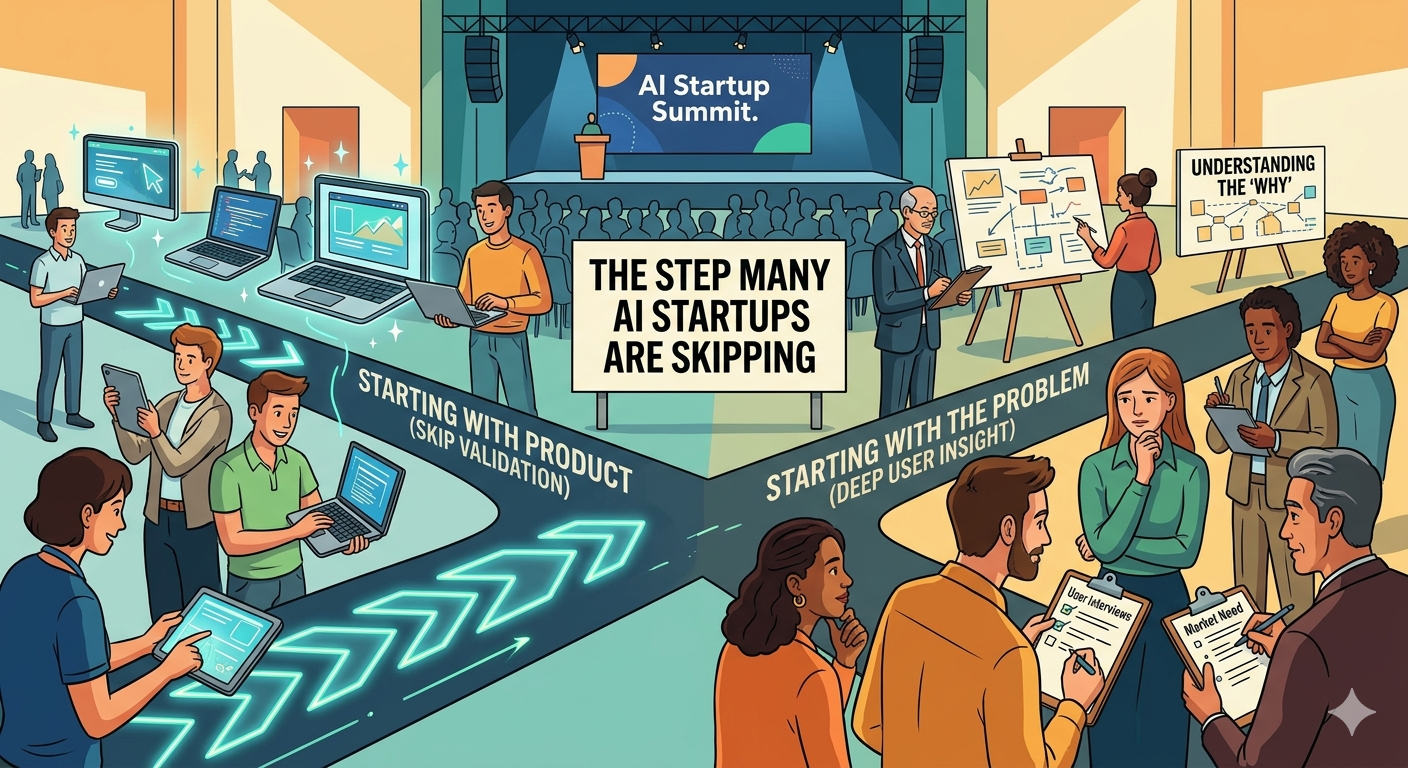
Experienced founders begin with the problem. New founders often begin with the product.
That difference may seem subtle, but it determines whether a startup ever finds real traction.
The Pattern Behind Weak Startup Ideas
Many startup conversations start the same way. A founder walks in with a polished product, a working prototype, and sometimes a well-designed landing page.
The demo looks impressive. The technology works. The idea sounds interesting at first glance.
But when the discussion moves deeper into the problem itself, things become less clear. Who exactly is struggling with this issue? How painful is it in their day-to-day work? What are people currently doing to deal with it?
Often the answers are vague.
The product exists, but the problem is still fuzzy. And when the problem is fuzzy, users rarely care enough to adopt the solution.
This is where many startups quietly fail long before the market ever notices them.
How AI Changed the Speed of Building
The current wave of AI tools has dramatically accelerated how quickly software can be built. Founders can now generate code, design interfaces, write documentation, and assemble prototypes in a fraction of the time it once required.
What previously took months of engineering effort can now happen in a few hours or days.
From a technological perspective, this is an incredible shift. It allows more people to experiment with ideas and dramatically lowers the cost of launching products.
But it also introduces a new challenge.
When building becomes extremely easy, the discipline around deciding what should be built often weakens.
Why Validation Matters Even More Now
Before AI development tools became widely accessible, building software required significant effort. That effort naturally forced founders to slow down and examine the problem carefully before committing months of work.
They talked to potential users. They studied how people were solving the problem today. They tried to understand whether the issue was painful enough for someone to care about.
Today that step is easier to skip.
If a prototype can be built in a weekend, many founders prefer to start coding and figure out the problem later. The temptation to move fast becomes stronger than the discipline to validate the idea first.
The result is visible across the AI startup ecosystem. New tools appear every day, many technically impressive but solving problems that are either minor or poorly defined.
Technology is moving faster than problem discovery.
What Experienced Founders Do Differently
The founders who consistently build meaningful companies tend to approach the early stages differently. Instead of starting with features or technology, they spend time understanding the environment around the problem.
They observe how people work, where they struggle, and how existing systems fail. They ask questions about how much time or money the problem costs and whether people would actively search for a better solution.
These conversations often reveal whether an idea has real potential long before a product is built.
When the problem becomes clear and painful enough, the direction of the product usually becomes obvious.
A Simple Way to Pressure-Test Startup Ideas
Because this step is increasingly overlooked in the AI era, I put together a simple way to pressure-test startup ideas before founders spend months building them.
The idea is straightforward. Instead of immediately jumping into development, the concept is run through a series of practical checks focused entirely on the problem itself.
It forces founders to confront questions such as whether real people are struggling with the issue, whether current solutions are failing badly enough, and whether someone would realistically pay for a better outcome.
Sometimes the answers confirm that the idea has real potential. Other times they reveal that the opportunity is weaker than it first appeared.
Building Startups in the AI Era
AI is not the problem. In fact, it is one of the most powerful accelerators founders have ever had access to.
Once a meaningful problem is clearly understood, AI can dramatically shorten the path from idea to product. Prototypes can be built quickly, tested with users, and refined in rapid cycles.
The advantage comes from combining strong problem insight with the speed AI now provides.
But when the problem itself is unclear, building faster rarely improves the outcome. It simply means the wrong product reaches the market sooner.
The Real Advantage Founders Need
AI will continue to make building software easier and faster. The tools will improve, and launching products will become increasingly accessible.
But the real advantage in startups has never come from how quickly something can be built.
It comes from understanding problems deeply enough to build something that people genuinely need.
In a world where products can be created overnight, the founders who win will be the ones who take the time to understand what truly deserves to be built in the first place.