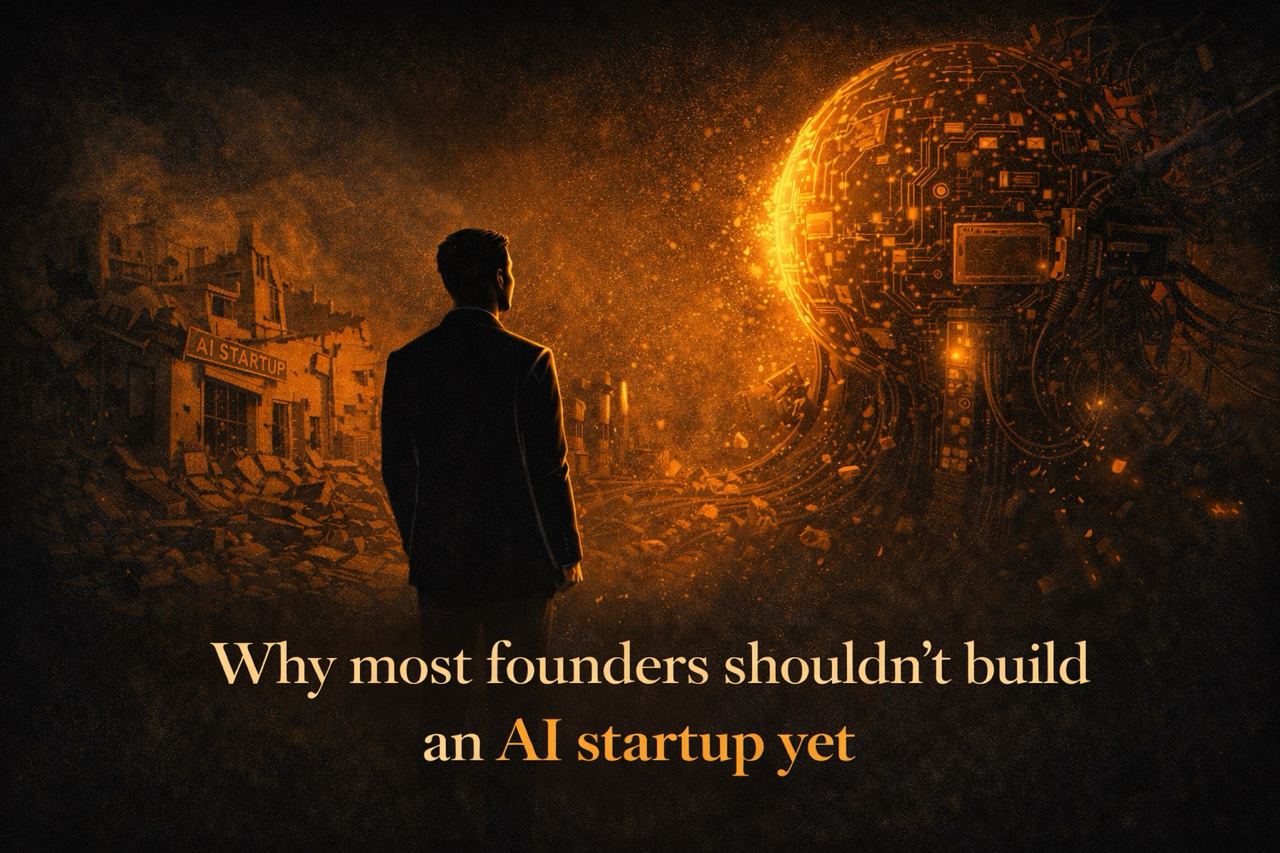
Most founders aren’t building AI companies. They’re reacting to one.
There’s a difference. And that difference is why most of what’s being built right now won’t exist in three years.
What founders are getting wrong
The pattern is consistent. A new capability emerges. Founders see it. They start building around it because the technology made something possible, and they were standing nearby when it did. That’s a starting gun everyone heard at the same time.
I’ve watched this cycle before. Different technology, same outcome. The founders who move first on a capability rarely win. The ones who win understood why the capability mattered to a specific person in a specific context. That understanding takes longer to develop than a prototype.
Most AI startups being built today share one structural flaw: designed around what the technology can do, built ahead of what a market is ready to pay for, integrate, and depend on. Capability is demand in your head. A demo is distribution in your head. The market has different opinions.
The wrapper problem gets discussed constantly but the conversation stays shallow. Building on top of someone else’s model means building on top of a model that gets cheaper, smarter, and more directly accessible to your customers every few months. Margin compresses. Differentiation erodes. The incumbents in your vertical, the ones with relationships, sales teams, and existing trust, are quietly running internal pilots. They don’t need to acquire you. They just need to outlast you.

Most teams figure this out in year two, when CAC stops making sense and renewals start softening.
There’s also a fundamental misread happening around what users actually want. Outcomes, full stop. A finance team wants accurate closes and fewer errors. If AI delivers that invisibly inside a tool they already trust, they’ll never once think about the AI. When your entire brand is built around the AI being the product, you’ve already positioned yourself for the wrong conversation. You’re selling the engine when people are buying the ride.
The traction signals are getting misread too. Waitlists, demo traffic, early pilots. These measure curiosity. Curiosity converts fast and drops off faster. Habit formation is slow. Most founders are building financial models on the curiosity curve and calling it retention.

The timing problem
The more precise diagnosis is this: most founders are early in the wrong layer.
The infrastructure is still actively shifting. Model costs are dropping. Context windows are expanding. Capabilities that defined entire product categories six months ago are baseline features today. What you architect against now may be irrelevant to how the market buys in eighteen months. That’s a reason to be precise about your bet. Most founders are choosing speed over precision.
Enterprise behavior hasn’t settled either. Procurement still doesn’t know where AI tools sit. Legal is writing policy in real time. Compliance in regulated industries is unresolved. The buying journey is fragmented across IT, operations, and individual departments running shadow budgets. A fragmented buyer makes a repeatable sales motion impossible. Without that, you have a funded experiment.
Being early carries a cost most cap tables ignore. When the market is still forming, you spend runway educating it. Then someone with more capital, better distribution, or a cleaner product arrives two years later and captures what you warmed up. You absorbed the cost. They took the return.

AI adoption is following a specific sequence: hype, partial adoption, fatigue, then quiet and durable integration. Most founders are optimizing for the hype phase. The companies that matter will be built in the integration phase, when buyers know what they want, procurement knows where it belongs, and the question shifts from “should we use AI” to “which solution do we trust.”
You don’t want to be first to that market. You want to be right.
What actually matters
The founders building durable companies here share one thing: they understood the problem before they touched the technology.
Distribution first. In a market where the product layer commoditizes faster than teams can iterate, the moat is the relationship. Who trusts you enough to build a workflow around you? Who renews because switching is genuinely expensive? Distribution is owned, earned, or borrowed. Virality borrows it. Content earns it slowly. The teams with real staying power have some version of owned distribution before launch. That’s a pattern, not a coincidence.
The founders I’ve seen build real traction spent years inside a specific problem before they started building. The dysfunction was the idea. The AI made the solution economically viable for the first time. That sequence matters enormously. Start with the technology and you go looking for problems. Start with the problem and you recognize the technology as the unlock. Those produce different companies with different odds.
Systems thinking over tool building. The right question is what this workflow looks like in three years, where AI sits inside it, and what position you want to hold in that system. Most teams are asking what they can ship by next quarter.
If your advantage disappears when the underlying model improves, you have a head start. Head starts get competed away. Advantages compound.
What to do instead
The most under-explored territory in AI is the industries where it’s being applied poorly, partially, or too early to have attracted serious competition. Productivity tools, coding assistants, marketing automation, customer service: crowded, loud, well-funded. Industrial operations, mid-market professional services, infrastructure, specialized finance: early, high-leverage, and full of buyers who care about outcomes over aesthetics.
Build with AI before you build for AI. Run it through actual internal workflows. Find where it breaks, where it creates new failure modes, where a human still needs to be in the loop and why. That operational understanding is the thing that separates founders who know the technology from the outside from those who’ve lived inside it. It becomes product instinct. It shows up in every decision. Most founders skip this because they believe speed is the edge. The ones who don’t are building things that feel different when you use them.
Build leverage, full stop. A feature can be copied in a sprint. Leverage is a position that strengthens over time: a proprietary dataset, a distribution channel, a brand a specific market trusts, a workflow that becomes load-bearing inside a customer’s operations. Before you raise and hire, the question worth sitting with is: what makes this harder to compete with in year three than in year one? If the answer takes more than a sentence, the company needs more thinking before it needs more capital.
The reframe
Most people are asking the wrong question about AI startups.
The question is which layer you’re building at, and whether that layer holds when the market catches up to where you are now.
Most founders are at the capability layer, the exact layer the infrastructure providers are actively commoditizing. A smaller number are at the workflow layer, where integration depth and domain trust create stickiness that models alone can’t replicate. Fewer still are at the system layer, where they own a position inside an industry’s operating logic that becomes more valuable as AI becomes more prevalent.
The founders who will look sharp in hindsight identified their layer early and built for it with precision.
Timing is a strategic decision, not a circumstance. Most founders treat it like weather. The ones building lasting companies treat it like a variable they can control.
The opportunity in AI is real. The gold rush mentality is the liability. Gold rushes reward speed. Markets reward position.
Know which game you’re actually playing.