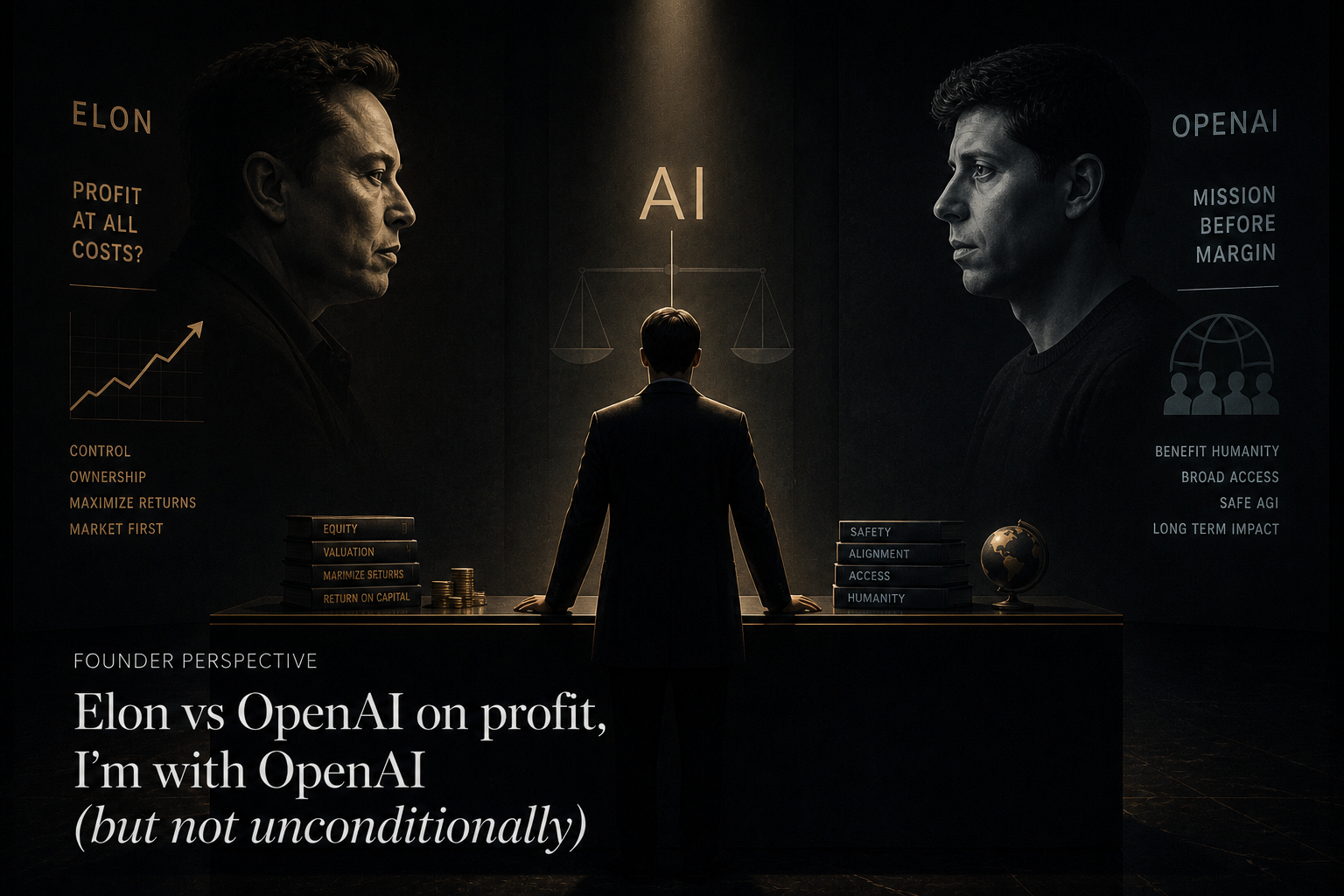
Right now in Oakland, the Musk v. Altman trial is being framed as a philosophical battle. Elon accuses OpenAI of betraying a charity OpenAI describes Elon as a jealous competitor attempting to hit the brakes on them. Both framings are convenient. The truth is messier and more compelling.
My Position: OpenAI was absolutely correct to go for profit. However they dealt with Elons early contributions was messy and pretending different doesnt help anyone.
Did going for-profit betray the mission?
OpenAI and Elon both agreed in 2017 there needed to be a for-profit component to OpenAI given the vast amounts of money that would have to be raised to realize the mission. This is not some minor detail that hides in a footnote. It was an understanding that existed among the very people seated in a courtroom disputing it.
The reason is straightforward. Frontier AI cannot be built on donations alone. The compute alone is staggering. OpenAI increased $40 billion at a $300 billion post-money valuation in March 2025 and is projecting an $8 billion payout for compute and other prices simplest in 2025. That math does not survive in any nonprofit structure. He would be writing thinks pieces today over how those idealists failed to compete against Google and Meta if OpenAI had remained a pure charity for long enough, I estimate around 2021 before it quietly died.
He testified that he does not oppose a for-profit unit of OpenAI. He complains that it became “the tail that wags the dog”. This is a valid and legitimate concern to voice. Governance reform, transparency and accountability structures address that concern, litigation intended to turn back the clock on a conversion he in effect once approved does not.
Elon deserved the same treatment with his $38 million.
This is where I break with the tidy narrative of OpenAI.
Musk says his contribution of $38 million in value to the firm was applied for unauthorised commercial purposes, and that he was not told about the structure. OpenAI, however, describes it as a donation, not an investment, one for which he also claimed a tax deduction. While that last bit is germane in theory, it does not, of itself, resolve the competing and much broader question at issue, intent versus fairness.
If you start something which later ends up being a multi hundred billion dollar company, some recognition that they are not the only factor is fair. Not a controlling stake. Not a veto. But fair recognition. The earliest backers, including Musk himself, have seen their stakes multiply over 100 times on paper but Musk got nothing while employees are now averaging $1.5 million in stock compensation. It is difficult to defend that asymmetry on pure moral grounds, even if it stands up legally.
Even worse, internal documents made public during pre-trial discovery. Greg Brockman himself Gave the Foreword that it would be “pretty morally bankrupt” to switch to a for profit company “without” Musk, and also asserted if they told musk with them on Board with non profit and then 3 months later advertising formed a per cost business “it was basically a lie.” Pretty hefty stuff from a cofounder. They do not prove fraud. But they demonstrate that the people inside OpenAI knew their ethical duty and made a decision in any case.
This is What it Looks Like from a Founders Seat
This is a common pattern that I see in early stage companies. Someone shows up early, risks everything when there is nothing, puts in money or reputation or both and then gets managed out or diluted into irrelevance as soon as the company flourishes. Often, that is done relatively cleanly, with fair treatment and honest communication. Sometimes it does not.
Elon has both benevolent and mercenary motivations, but his departure behavior did not help with credibility. Moreover, just last year, he spearheaded a group of investors who offered to purchase control over OpenAI for $97.4 billion, an offer Altman would immediately turn down. A man who is genuinely only motivated by principle does not write a letter about suing about nonprofit purity and then offer $97 billion for an acquisition. That detail matters.
However, mixed motives do not in and of themselves render the grievance nefarious. One can be true and the other can also: Elon can be motivated by at least some combination of competitive self-interest while having a point about what early contributers were aptly and unfairly deemed to have received.
The actual question worth asking
OpenAI turned itself into an USD800B giant on the road toward an IPO that may soon become one of the most highly valued entities in the world. It has been good with its staff. Microsoft has been given a reward with an investment of more than 200 billion and a stake in its own. The nonprofit foundation kept 26 percent of equity, approximately $130 billion.
The only even slightly interesting bit is that the sole person who made a financial and confidence-based contribution when the project was 99.9% dismissed by the rest of Silicon Valley as impossible leaves with nothing and gets called a liar for suggesting he had some expectations?
Going for-profit was correct. The business rationale holds up, the mission is still technically intact, and the alternative was obscurity. However you talk to early people (especially when the stakes get big) is a reflection on what kind of company you really are. It seems like OpenAI could have gotten creative and been a bit more generous. The part that does not sit well with me is the fact that they did NOT, then assigned all of the blame to Elon.
One can be right about the business but wrong in how they treated someone.