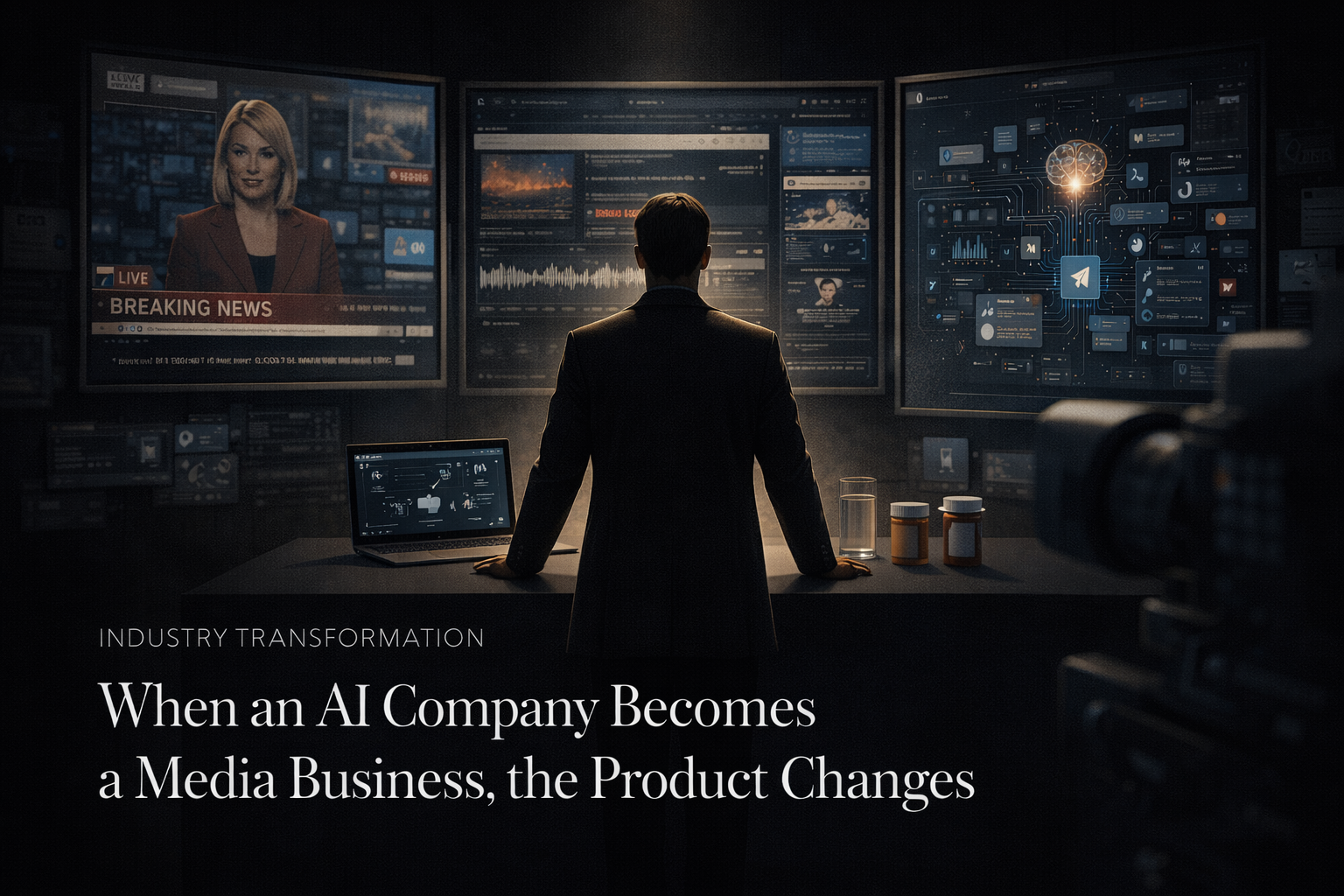
When an AI Company Becomes a Media Business, the Product Changes
OpenAI just told the world something important. Most people heard the number. They missed the message.
The projection is $2.5 billion in advertising revenue this year. $100 billion by 2030. A pilot that crossed $100 million in annualized revenue in under two months. Over 600 advertisers already in the system. By any measure, this is not an experiment. This is a business model.
And that changes everything about what OpenAI is.
There is a specific moment in a company’s life when its revenue architecture stops being a detail and starts being the product. Google crossed that line in the early 2000s and never came back. The search engine that organized the world’s information became, structurally, a machine for delivering audiences to advertisers. The results got optimized accordingly. Not through malice. Through incentives.
OpenAI crossed that line in January 2026. The ads are triggered by semantic relevance to the conversation, meaning the system analyzes the problem a user is trying to solve before serving a commercial placement. That is not a banner ad. That is intent harvesting at the most precise layer anyone has ever built. The user comes with a problem. The advertiser buys access to that moment.
OpenAI’s own language around this is telling: “our commitment to putting users first and maintaining trust won’t change.” Companies announce the commitments they feel pressure to make. The pressure exists because the conflict is real.
The acquisition of TBPN, a streaming network positioned as the media voice of Silicon Valley, arrived shortly after. A research lab turned product company turned advertising platform now owns a media property. The flywheel is visible. Own the AI. Own the audience. Own the narrative around both. Sell access to all three.
This is not a criticism of the business logic. The economics of frontier AI are brutal, and subscription revenue alone cannot carry a $600 billion infrastructure roadmap. The pressure to find revenue at scale is real. Advertising is a rational answer to an impossible cost structure. That part makes sense.
What deserves scrutiny is the framing that nothing changes.
When advertiser revenue becomes load-bearing inside an AI system, the incentives shift. Engagement starts to matter more than resolution. Surface-level answers that prompt follow-up queries are more valuable than deep answers that close the loop. The system that was optimized to be useful begins to optimize for something adjacent to useful. These shifts are gradual, structural, and very difficult to see from the inside.
Enterprise buyers selected OpenAI on a specific promise: an AI that prioritizes the user’s outcome over everything else. That promise is now sharing the room with a $100 billion revenue target built on advertiser access to user intent. Those two things can coexist for a while. Over time, under pressure, they tend not to.
The market is already reading this. Anthropic made OpenAI’s ad launch the centerpiece of its Super Bowl campaign. That is not a product decision. That is a positioning decision. The gap between ad-supported AI and subscription-supported AI is becoming a buying criterion, particularly in regulated industries where the question of whose interests the AI is serving has real legal and operational weight.
For founders and operators building on top of AI infrastructure, this moment is worth sitting with. The platform you are building on has a new primary stakeholder: the advertiser. That stakeholder’s interests will shape product decisions in ways that are subtle at first and structural over time. Understanding the incentive architecture of your infrastructure is not paranoia. It is due diligence.
OpenAI is not the first company to make this trade. It will not be the last. But the companies that made it before, the search engines, the social networks, the content platforms, all said the same thing on the way in: the user comes first, the ads are separate, the product will not change.
The product always changes.
The only question worth asking now is whether the AI that serves your business tomorrow is optimizing for you, or for the advertiser sitting one layer below the interface.
That answer is no longer obvious. And for anyone building something that depends on the answer being clear, that matters more than the revenue number.