The average Consensus Miami attendee still thinks of OpenSea the same way they think of Friendster. Someone used to care, but now it is just a crow which alerts you that nothing in crypto stays on top forever.
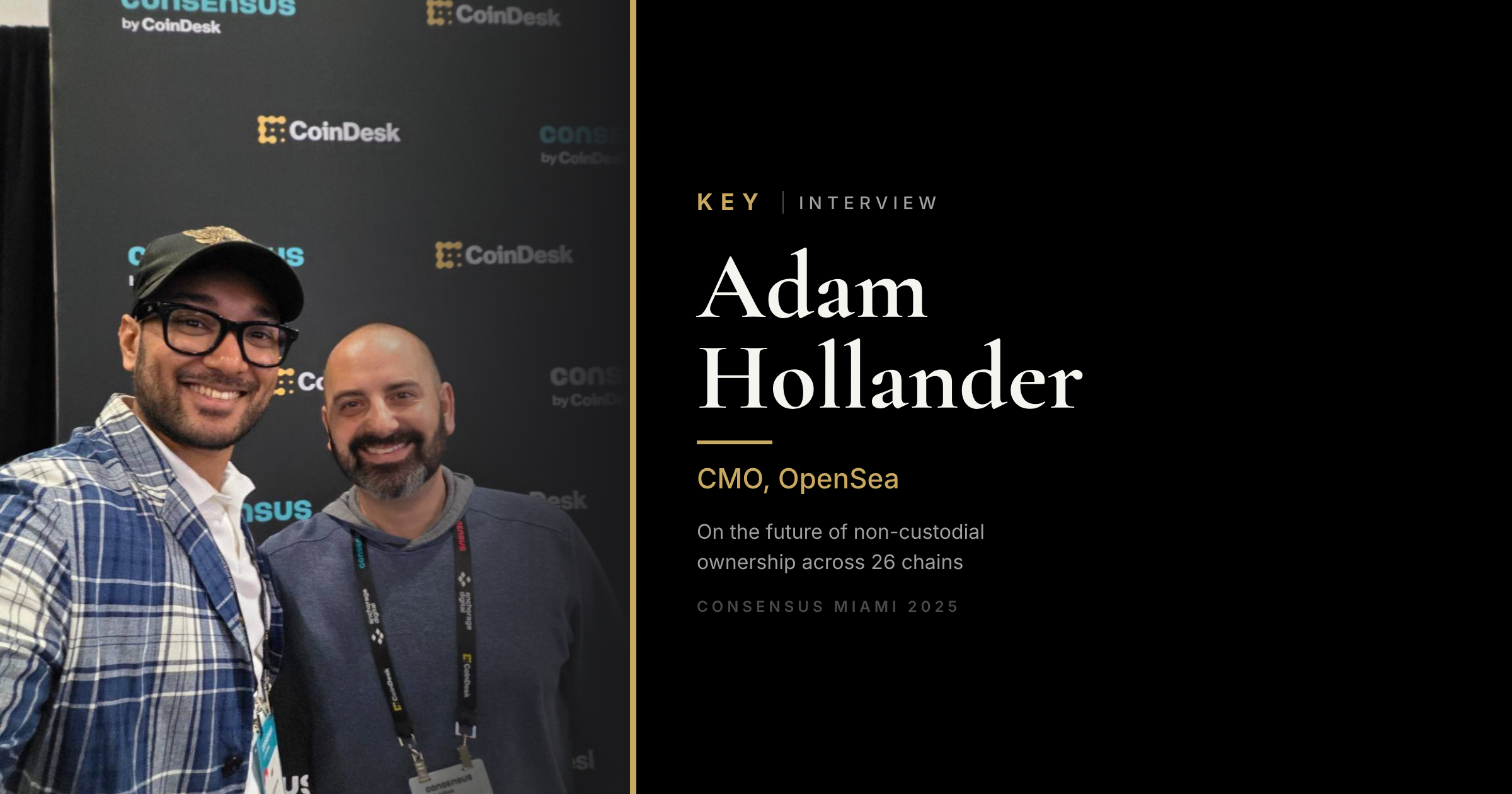
After I spoke with Adam Hollander, CMO of OpenSea, I walked away thinking the other way around. Not because the pitch was polished or anything, but because I had never heard such a clean version of this underlying logic laid out.
What started out with OpenSea owning some 90% of the NFT market share in 2022 saw it drop to roughly a third by early 2025. Nobody’s going to complain at $0, however Blur took ground with 0% fees and token incentives. The NFT cycle cooled. The firm also cut half of its work force. Externally, it appeared to be a leisurely withdrawal.
What actually unfolded was a rebuild.
The product was never the issue It was the rails.
As Adam put it bluntly, the original OpenSea was never designed to do what they wanted to do now. It wasn’t an engineering failure to add meme coins, perps, token trading and multilchain support to old infrustructure; it was architecturally impossible. So they scrapped it. OS2, released February 2025, is a rebuild from the ground up—not a collection of new features. Twenty-six chains. Token trading. Cross-chain purchases without manual bridging. Fees decreased from 2.5% to.5%.
It was not the feature list that caught my attention. Now you know why it was reset. Any other company would have patched and shipped. They opted for a fresh start, nearly always the tougher call and (nearly) always correct.
The custodial trap which no one discusses
The question worth sitting with is this: Over the last three years, we’ve mostly seen custodial consumer crypto products being successful. Retains ease of onboarding, a clean UI and their keys Coinbase, Robinhood crypto, PayPal’s crypto integration Source: Coinbase They grew. They work.
And OpenSea is precisely going the other way.
The case Adam makes is simple: Except for a handful of big custodial platforms, there is currently very little user-friendly support for NFTs or tokenized assets. Banks can not touch them. Custodial apps stay far away from them. The phrase stuck with me, however, “nobody goes near it with a 100-foot pole.” That is not a problem. That is a gap.
The bet is that non-custodial ownership becomes important to more people than today, and that the platform that aggregates NFTs, meme coins, real crypto ، and perps in one place will be where those people arrive.
I doubt most people are ready to truly care about custody of wallets. The crypto-native user most definitely does. In OpenSea already entices over a millions wallets inside its rewards system, and hundreds of thousands for every day on NFT trading + token. That are not an audience of legacy. That is a foundation.
How the mobile app is really trial by fire
That was the infrastructure play OS2 rebuild. The mobile app is the distribution play and those are two very different problems.
Something Adam got in to which I find genuinely interesting. It creates a wallet in seconds, allows users to press ⇕ twice on Apple Pay to purchase crypto, and redirects that value across 26 chains without any understanding of what a chain even is from the user. The OpenSea marketing and engineering teams have been putting 600 beta testers through the ringer with hour-long one-on-one sessions. And that’s not a typical beta process. That is product rsearch in the form of a beta.
What they actually want to know is if a non-custodial, wallet can be as frictionless as handing over your keys to someone. That is genuinely hard. Most attempts have failed. But it is the appropriate question to be asking.
The errors the buyers of 2021 made, and what OpenSea lost
I think this quote from Adam on the previous NFT cycle better clarifies a lot of what OpenSea is facing today than any market chart. In 2021 and 2022, most of the buyers had no interest in the art or community or using the utility. They bought because they hoped to sell higher to someone later than them.
When that trend flipped, the wheels came off. And OpenSea, which is still the largest marketplace by far, bore the brunt of reputational collateral for a moment that it did not fully create.
The case for NFTs, digital provenance, verifiable ownership that you can see where something came from and who held it — That hasn’t been made weaker. And it was just buried under two years of speculation unrelated to those properties.
OpenSea turned into that original thesis, is being rebuild. MCP already in the roadmap to offer agentic trading, slower, and without the frenzy. Depending on circumstances beyond the control of any one company, whether it is indeed time will vary.
But the ones we’ve done is all that logically make progress. The rest is literally just asking the users to trust someone else with their shit and I have watched that principle play out over time in every cycle, every time.